

Inside Look
Transform radiation into life-saving medical insights.
Learn to use X-rays to produce medical images of the body’s internal structures with Owens’ Radiologic Technology, AAS program. From spotting broken bones to identifying disease or guiding surgical procedures, radiologic technologists are essential members of interprofessional healthcare teams, collaborating with physicians, nurses and imaging specialists in fast-paced environments. Help to diagnose injuries and illnesses and earn the skills to make a difference in patients’ lives.
As a radiologic technologist, you’ll fuse both the technical and compassionate sides of medical imaging. You’ll capture high-quality images, adjust exposure controls, practice radiation protection and translate invisible details into vital diagnostic insights. Equally important, you’ll provide compassionate patient care by easing fears, explaining procedures, and ensuring comfort and safety.
Core strengths for a career in radiologic technology:
- Compassion and Communication: Building trust with patients and collaborating with healthcare teams.
- Attention to Detail: Capturing accurate, high-quality images while ensuring safety.
- Technical and Critical Thinking Skills: Mastering complex imaging equipment and adapting to each patient’s needs.
Small Classes. Expert Guidance.
At Owens, you have a team of dedicated, experienced professionals guiding you. In turn, your faculty will be supported by an Advisory Committee of local professionals.
Our instructors are experts who take pride in your success. Combined with our small class sizes, you’ll get one-on-one mentorship and precise technical feedback tailored to your goals.

Award Type
Associate of Applied Science (AAS)

Department
Department of Radiologic Technology

Required Credit Hours
62-65
Real Results
50+
Years of JRCERT-accreditation, ensuring eligibility for ARRT certification
89%
Pass rate on the first attempt for the ARRT credential exam
1,300
Hours in clinical education at regional clinical facilities
Bones to Beams: The Science Behind the Image
You’ll start with the essentials, learning the scientific principles behind X-ray production and imaging technology through radiologic physics. You’ll study the structure and function of the human body in anatomy and physiology—knowledge that’s critical for accurate patient positioning and precise image interpretation.
Explore sectional anatomy for medical imaging, gain valuable insights into medical informatics and develop the interpersonal skills to effectively connect with patients and collaborate with healthcare teams.
Real-World Experience
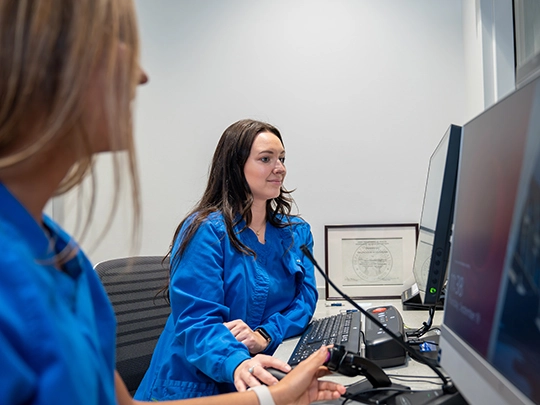
Throughout the program, you’ll apply what you learn in two fully functional radiography labs on campus and accumulate a total of 1,300 hours in clinical education at regional healthcare facilities. This pairing of classroom learning with directed clinical practice ensures you gain real-world experience under the guidance of experienced technologists in professional healthcare settings.
By your final semesters, you’ll complete advanced radiologic technology coursework and extensive clinical rotations, culminating in a capstone experience that thoroughly prepares you for the ARRT credentialing exam and immediate workforce entry.
Specialization Opportunities
You can specialize in computed tomography, mammography, bone densitometry, interventional and cardiovascular imaging. In your second year, you’ll have the opportunity to complete a Computed Tomography Certificate and gain additional clinical experience in CT after completing the program.

Program Mission and Goals
Program Mission Statement
The Radiography Program at Owens Community College is dedicated to preparing skilled, compassionate, and professional radiographers who uphold the highest standards of patient care, technical excellence and ethical practice in the healthcare community.
Program Goals and Outcomes
Goal 1: Students will be clinically competent.
- Students will demonstrate patient care skills.
- Students will select appropriate technical factors.
Goal 2: Students will utilize critical thinking skills and problem-solving skills.
- Students will analyze image quality.
- Students will utilize critical thinking in the performance of Radiographic procedures.
Goal 3: Students will utilize communication skills effectively.
- Students will demonstrate effective verbal skills.
- Students will demonstrate effective written skills.
Career Outcomes
You’ll graduate fully prepared to sit for the national certification exam through the American Registry of Radiologic Technologists (ARRT). Passing this exam is required to practice as a radiologic technologist. Some states, including Ohio, require additional licensing.
Radiologic technologists are in high demand nationwide, offering excellent job security and growth potential. The profession provides competitive salaries, flexible work environments and diverse employment opportunities—from hospitals and urgent care centers to outpatient clinics and specialized imaging facilities.
As you advance in your career, you can specialize in high-demand areas such as CT, MRI, mammography or interventional radiology, each offering unique challenges and enhanced earning potential.
Explore the employment data to understand trends in our area.
Educational Advancement Options
This degree provides a strong foundation that transfers seamlessly to four-year institutions, should you choose to pursue a bachelor’s degree. Advanced education opens doors to leadership roles in clinical supervision, education, administration and healthcare business management.
Owens maintains articulation agreements with several respected universities, including Bowling Green State University, Grand Canyon University, Mercy College and the University of Cincinnati, ensuring smooth credit transfer and continued educational pathways.

In Their Words
“I am from a small town and I liked the idea of having small classes. The hometown feeling translated to the community feel I had with my instructors. I was able to directly talk to them when I needed help.”
Leigha Egnor, Radiologic Technology, ’24

Selective Admission
Radiologic Technology Program, AAS is a “Selective Health” program—meaning we can only admit a limited number of students each year. Prospective students should apply to Owens first, then to the Radiologic Technology program. Class admission uses a point-based system based on your academic record.
First, we look at your grade point average (GPA). Next, bonus points are awarded for most Radiologic Technology general education courses earning a C or better. If you haven’t taken enough of those courses, we look only at your high school GPA. General education courses can be taken before you’re admitted to the program.
If you choose a different program at Owens, these general education courses may also count toward it. Work with your advisor early and often if you are considering multiple programs. See how the points work.
For clinical placement, you are required to submit documentation of a completed health exam, background check and additional requirements.
Review this important information about the Radiologic Technology, AAS Program:
Accreditation
The Radiologic Technology Program at Owens Community College is accredited by the Joint Review Committee on Education in Radiologic Technology at 20 N. Wacker Dr., Suite 2850, Chicago, IL 60606-3182. Phone: (312) 704-5300 | Email
The program’s current award spans 8 years, from 2025 to 2033. General program accreditation information and the current accreditation award letter can be found on the JRCERT website.
Contact Us
Christine Smith
Chair
Health Education Center 132 K
Toledo-area Campus
Phone: (567) 661-7376 | Email
Jennell Twigg
Clinical Education Coordinator
Health Education Center 133 S
Toledo-area Campus
Phone: (567) 661-7245 | Email
New Owens Students
You’re ready to begin your radiologic technology journey and still need to apply to Owens.
Current Owens Students
You’re already an Owens student and ready to get started on your radiologic technology journey.